

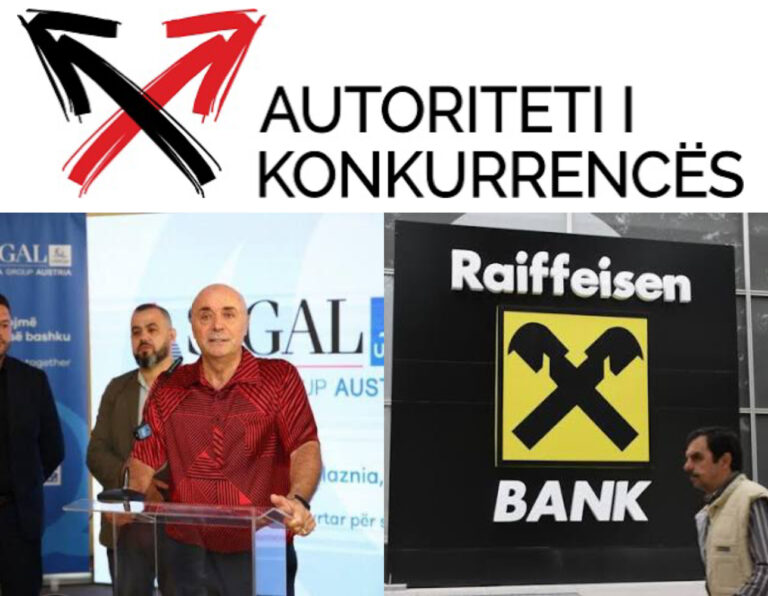
€16 million in alleged abuses: Raiffeisen–SIGAL agreement linked to Avni Ponari secured up to 90% profit margins
New details have emerged regarding an investigation by the Competition Authority into several major banks in the country, suspected of violating Articles 4 and 9 of the Law on the Protection of Competition.
Investigation into mandatory life insurance practices
The investigation focuses on intermediation practices related to the sale of life insurance policies, which banks require certain borrowers to purchase—particularly those taking out mortgage loans.
This type of insurance is designed to ensure that, in the event of the borrower’s death before repaying the loan, the insurance company will cover the outstanding debt.
Life insurance revenues reach ALL 1.64 billion
According to data from the Financial Supervisory Authority, this product generates approximately ALL 1.64 billion (around €16 million) in gross revenues for insurance companies.
What Articles 4 and 9 stipulate
Article 4 of the Law on the Protection of Competition prohibits agreements between two or more market operators aimed at restricting competition—for example, fixing prices, limiting supply, or imposing restrictive conditions on consumers.
Article 9 prohibits companies with a dominant market position from abusing that dominance.
The case of Raiffeisen Bank and Sigal Life
One specific case under scrutiny involves Raiffeisen Bank, which is suspected of selecting only Sigal Life as its partner for life insurance products. This arrangement effectively limits customers’ ability to choose more competitive offers available in the market.
Documents obtained indicate that, for consumer loans, the commissions applied to Sigal Life are:
• 50% of collected premiums for the “standard insurance package”
• 45% of collected premiums for the “extra package”
During the investigated period, approximately 39,000 insurance policies were issued exclusively through Sigal Life, representing around 90% of the life insurance market tied to loans issued by Raiffeisen Bank. This suggests a highly concentrated market structure and raises serious concerns about fair competition.
Mandatory borrower life insurance
Borrower life insurance is effectively a mandatory product imposed on loan applicants, primarily to protect banks by ensuring loan repayment in case of unforeseen events affecting the borrower.
According to official data, around 118,000 Albanians purchased such policies in 2024.
Rapid growth of the life insurance market
Data shows that the number of individuals required to purchase borrower life insurance has doubled—from 59,000 in 2019 to 118,000 in 2024.
Revenues from these policies have increased by 112%, indicating not only higher demand but also a rise in the average premium price.
Profit margins reaching up to 90%
Insurance companies paid out claims equivalent to only 10% of collected premiums in 2024. This implies gross profit margins of up to 90% for this product—an unusually high figure that points to limited competition and potential consumer harm.
Between 2019 and 2024, consumers paid approximately ALL 6.6 billion for borrower life insurance policies, while insurance companies paid out only ALL 843 million in claims—about 12% of total revenues.
Banks under investigation
According to the official statement, the conduct of several institutions—including Raiffeisen Bank, OTP Bank Albania, National Commercial Bank, Tirana Bank, Intesa Sanpaolo Bank Albania, Union Bank, ABI Bank, ProCredit Bank, and others—may constitute violations of Articles 4 and 9 of the competition law.