EXCLUSIVE: Privacy Alarm! After Gaining Access to e-Albania, Jet Bank Admits It Shares Albanians’ Data with Third Parties
By InfoNews.al
A new issue concerning the privacy of Albanian citizens is raising questions about how personal data is collected, processed, and managed within the country’s financial system.

Jet Bank, which recently entered the Albanian market promising a faster and more digital banking experience, has announced that it has integrated an electronic process for retrieving data from state registers through the e-Albania government platform.
According to the bank, the development is intended to simplify the loan application process, making it faster and more efficient while reducing traditional paperwork.
But behind this digital convenience lies a fundamental question for every citizen:
What happens to Albanians’ personal data once it enters a bank’s systems, and who may have access to it?
Jet Bank Admits: Personal Data May Be Shared with Third Parties
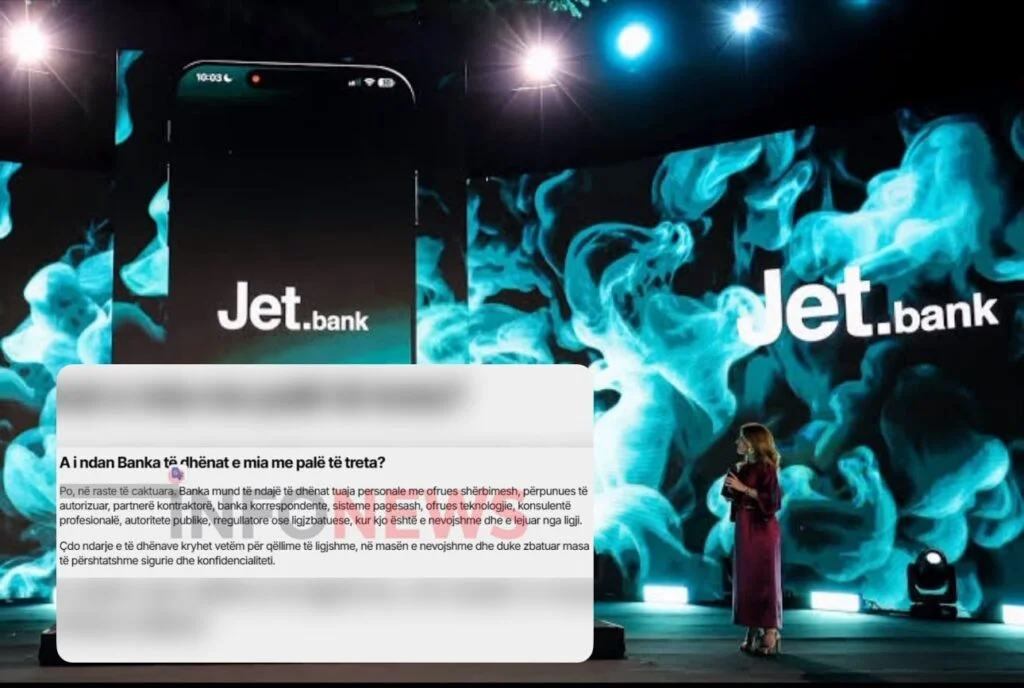
According to Jet Bank’s official documentation on the processing of personal data, obtained by InfoNews, customers’ information is used for identification and verification, opening and managing accounts, providing banking products and services, processing transactions, communicating with customers, and complying with legal and regulatory obligations.
However, the bank also acknowledges that personal data may, in certain circumstances, be shared with third parties.
The most significant point of concern relates to the sharing of information. According to the bank’s disclosure, personal data may be shared, where applicable, with:
service providers;
authorized data processors;
contractual partners;
correspondent banks;
payment systems;
technology providers;
professional advisers;
public, regulatory, or law-enforcement authorities.
The bank states that such sharing is carried out only for legitimate purposes, to the extent necessary, and subject to appropriate security and confidentiality measures.
Nevertheless, given that Jet Bank is now obtaining electronic access to data from state registers through e-Albania, a number of questions remain:
What specific data will be retrieved from state registers?
How long will this data be retained?
Which companies or other entities may be involved in processing it?
Can this data be transferred outside Albania?
From Traditional Banking to Digital Banking: Convenience vs. Privacy
Banks are increasingly moving toward automated digital processes, allowing customers to complete many procedures online without having to visit a physical branch.
But while technology brings speed and convenience, it also creates a significant responsibility: ensuring the protection of citizens’ personal information.
Financial, identification, and administrative data are among the most sensitive categories of information a person possesses. For this reason, transparency regarding how such data is collected, stored, processed, and shared is a matter of clear public interest.
Jet Bank argues that electronically retrieving data will benefit customers by making the lending process simpler and more efficient.
However, citizens are entitled to ask a straightforward question:
How much control do they retain over their personal information once it enters the banking system?
InfoNews.al will continue to follow this issue and seek greater transparency regarding the use and processing of Albanian citizens’ personal data within the country’s emerging digital banking infrastructure.
© Copyright InfoNews
This article is an exclusive publication of InfoNews and is protected under Law No. 35/2016 on Copyright and Related Rights. Republishing by other media outlets is permitted only with proper attribution to the source and inclusion of the original source link. Any unauthorized use may be subject to the applicable legal provisions.