

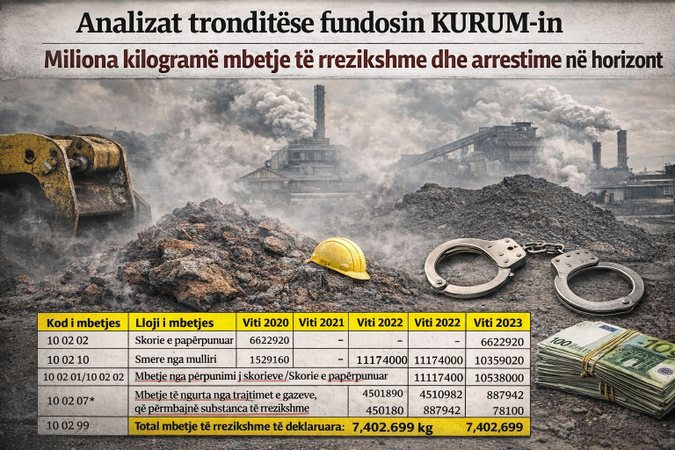
Shocking analyses threaten to bring down KURUM: Hazardous waste and arrests on the horizon
The KURUM waste scandal has long been simmering beneath the surface, while public interest appears to have been sidelined in favor of private corporate interests. What began as a technical environmental issue has today taken on alarming proportions and is turning into a serious test of the real functioning of Albanian institutions.
Confidential sources report that the results of the analyses were shocking. The waste samples examined showed extremely high levels of toxicity and were classified as hazardous not only to the environment but also to public health. The samples were sent for testing to a laboratory in Italy, but as soon as the results returned to Albania, they became a “hot potato” that no one wanted to hold.
Institutions began shifting responsibility from one to another, triggering open clashes and unusual delegations of authority. The situation was reflected directly within the National Environment Agency (AKM), where tensions erupted publicly.
On January 27, the Director General of AKM, Marjeta Përlala, delegated her powers to her trusted subordinate, Elona Uzmutlu, in a move that sources within the institution link to concerns over the progress of the investigation.
However, Uzmutlu had not yet entered the director’s office when the Minister of Environment, Sofjan Jaupaj, issued a new order transferring the powers of AKM’s Director General to another individual, Athanas Karaja. Within a matter of hours, the institution found itself with two parallel leaders, while responsibility was left without any clear address.
Meanwhile, developments in the KURUM waste case are expected to bring an even stronger confrontation between the agency’s leadership and the new minister, as interests and decision-making appear to be moving in opposite directions. What remains unclear is the concrete responsibility of Albanian institutions for the transportation of waste classified as hazardous from the Port of Durrës, and the role of each link in this chain.
The situation becomes even more alarming when the figures are taken into account. In just 12 calendar months, more than 10.4 million kilograms of hazardous waste were produced in Albania. According to documentation obtained by Piranjat News, the exact amount reaches 10,437,105 kilograms and includes untreated slag, waste from slag processing, waste from the treatment of gases containing hazardous substances, as well as waste from the iron and steel industry.
Such a volume should have triggered alarm bells across every state institution, yet for years it passed without public attention.
The scandal came to light only when two ships that had departed from the Port of Durrës toward Thailand were stopped by Thai authorities, after suspicions were raised that they were carrying hazardous waste. The ships were sent back, while it is still unknown today whether Albanian authorities will accept these shipments or not. Documents, signatures, and those responsible remain shrouded in darkness.
According to available data, KURUM’s hazardous waste was transported through the company “SOKOLAJ” SHPK under sales contracts. The company was founded in 2006 by Gjovana Sokolaj and her husband Doni Sokolaj, with activities focused on the import-export of minerals and the transport of hazardous waste.
Over the years, its shareholder structure has also included Turkish national Serdar Can Hakliol, who is likewise a partner in the company “Florester Metalik.”
“SOKOLAJ” SHPK has financial interests in Turkey and has entered into contracts with the company “Hakliol Madencilik.” From 2014 to 2023, transfers to this company amounted to 319 million lekë, or approximately 3.2 million euros.
In 2022, the company was granted a license for the transport and collection of hazardous waste, signed by then-Minister Mirela Kumbaro. One year later, this license was amended to include code 12 01 17, which covers waste from explosive materials.
And it is precisely here that the question arises to which institutions are not giving the public an answer: what explosive materials are involved, which entities produce them, who uses them, and who guarantees their safety?
Today, the case file is in the hands of the prosecution and law enforcement authorities. But while investigations continue, the waste remains, the risk persists, and responsibility continues to wander from one office to another.
The only question now is whether this case will finally bring answers and accountability in the coming weeks, or whether it will end like so many others before it—buried under the ash of industrial slag.